
A Very British Education
The prep school, in the form most people would recognise today, took shape across the 19th century. It grew to meet a practical need: how do you educate children when their parents are posted abroad for years at a stretch, in an era when the journey home took months rather than hours? The answer was a structured, residential system designed to hold a child's education steady regardless of where the family was. It worked rather well. It adapted. It co-educated, internationalised, and became the most imitated educational model in the world.
The families navigating it today are as likely to be based in Dubai or Geneva as the home counties. The system, for its part, has barely seemed to notice. The terminology is largely unchanged. The bones are intact. And the question most internationally minded families eventually arrive at is not whether a British education is worth pursuing, but how to actually go about it.
Worth understanding properly.
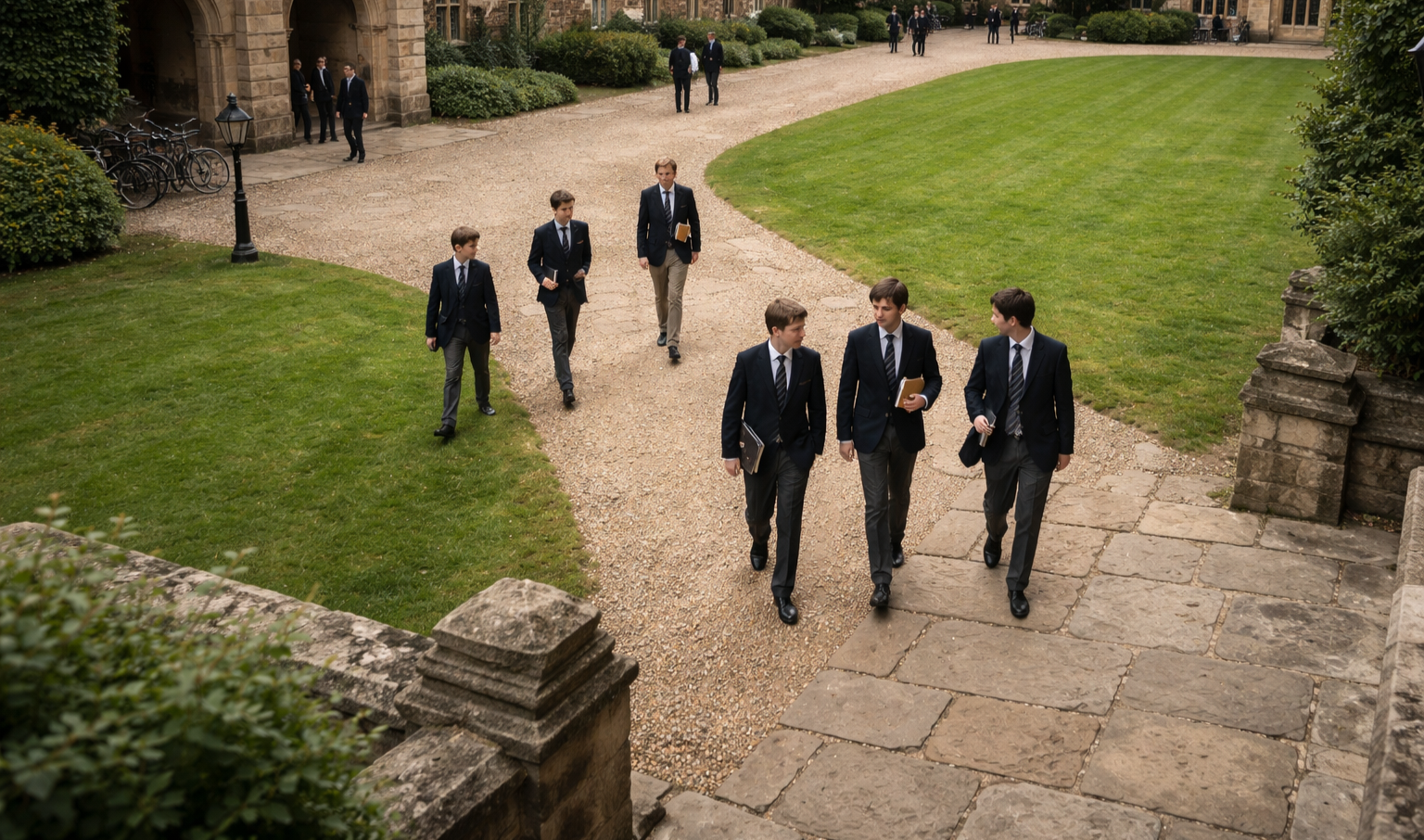
The stages
For many families, a British independent education begins earlier than expected. Independent nurseries take children from around two or three, with mornings building gradually towards full days. The focus at this stage is play-based, social and deliberately unhurried. The independent nursery is not the same as childcare, however gently that distinction is made. There are expectations, and they begin here.
For families with London schools in mind: waiting lists at the most sought-after pre-preps open early. Some fill nursery places years in advance. It is worth making enquiries sooner rather than later.
Pre-prep typically covers Reception through to Year 2, occasionally Year 3. Independent schools are not required to follow the National Curriculum and are free to set their own course. The best of them go further and faster across the board, while remaining genuinely appropriate to the age of the children in front of them. Class sizes are small, the pace is set by the school rather than a government framework, and the range of subjects taken seriously from early on is broader than most parents expect.
Prep schools vary in shape. Some run from nursery all the way through to thirteen, continuity built deliberately into the structure. Others begin at seven or eight and exit at eleven or thirteen depending on the senior school pathway. From the middle years of prep, teaching becomes more specialist and subject-led. Sport, music and drama are taken as seriously as the academic core, not as add-ons to the day but as part of its architecture. Many prep schools run a house system, introducing something that is harder to quantify than a timetable: belonging to something, competing for something, losing occasionally and coming back anyway.
The move to senior school is the pivot around which most admissions planning turns, and it happens at either eleven or thirteen depending on the school and the pathway. It is a more complex juncture than it first appears, and the timeline for preparing is considerably earlier than most families new to the system expect.
For entry at eleven, the main route into London's leading independent day schools, most institutions use the ISEB Common Pre-Test in the autumn of Year 6, followed by their own written papers and interviews in the new year. Registration at the most competitive schools closes well before this, in some cases during Year 5. The earlier a family begins to understand the landscape and prepare, the better.
For entry at thirteen, the traditional route into the leading boarding schools, the process begins earlier still. Pre-testing typically takes place during Year 6, with conditional offers following in Year 6 or 7, and Common Entrance sat at the end of Year 8. Registration at many schools closes during Year 5. Families who come to this process late are not without options, schools do have late places and emergency placements are navigable with the right guidance, but the most selective institutions reward early planning above almost anything else.
For families based outside the UK, most schools have established routes for international applicants, including assessments that can be taken abroad and remote interview options. Processes vary school by school and are worth understanding specifically for each institution on a shortlist.
At sixteen, students sit GCSEs across a broad range of subjects. From there, the pathway divides. A-Levels offer depth: three or four subjects studied over two years, with real academic weight that is well understood by universities worldwide. The International Baccalaureate offers breadth: six subjects across two years alongside a wider core programme. It travels internationally and suits students who want to keep multiple doors open.
Both are genuinely good options. The choice between them is personal and worth taking seriously, not simply defaulting to whatever the school happens to offer.
Neither is the superior option. They are different propositions and the question of which suits a given family is worth sitting with honestly.
London's independent day schools, among them St Paul's Girls', Westminster, City of London, Alleyn's, Dulwich and Godolphin and Latymer, offer exceptional academic environments alongside daily family life. The city is an extension of the education. The child comes home in the evenings. For families with roots in London, or those who want their children embedded in the life of the city, this combination is hard to beat.
Boarding offers immersion. Academic life, friendships, sport and personal development unfold together, over years, within a single institution. For globally mobile families it has a particular logic: the school becomes a stable home regardless of where the family is based. A child can remain in one place, with consistent relationships and an unbroken academic pathway, while the family navigates whatever comes next. The housemaster or housemistress relationship sits at the centre of this. It is not a classroom dynamic but something broader, covering the full shape of a child's life within the school across the years.
The question is not which is more prestigious. It is which is right for the child.
What it actually produces
The academic results are real. They are also, if you spend time with the families who have been through this system, rarely the first thing mentioned.
British independent education runs on argument. Children are expected to have views and to defend them, but more importantly to revise them when the evidence demands it. The essay, properly taught, is a form of thought rather than a vessel for received opinion. The expectation of effort is held across everything, not only the subjects a child has already decided are their strong suit. And then there is losing: the match, the debate, the music prize, the part in the play. British schools generate a remarkable number of situations in which children do not get what they want, in front of their peers, and carry on. It turns out this is among the most useful things an education can teach.
By the sixth form, the cumulative result of all this, not the grades but the formation behind them, is generally a student who can hold a position, write a clear argument and perform under pressure. This is not incidental. It is the point.
A British education from abroad
For families based outside the United Kingdom, the question is not always whether to pursue a British education but how.
British curriculum international schools exist across the Gulf, Europe and Asia. Quality varies considerably. The label guarantees nothing, and understanding the difference between a school that genuinely delivers a British education and one that simply uses the branding requires more than reading an inspection report.
For families in transit, between countries, between school years, or mid-relocation, private tuition can maintain a British curriculum pathway without losing continuity or ground. A child preparing for senior school entry from Dubai, bridging a gap between schools in Geneva, or keeping A-Level work intact during a family move, can do so effectively with the right support.
Beyond tuition, families based overseas often need help navigating the UK admissions process itself: identifying the right schools, understanding the timelines, managing applications from a distance and knowing when a visit to the UK is worth making and when it is not. We work with families at every stage of this, whether they are applying to UK schools from abroad, seeking the right British curriculum school in their current country, or doing both at once.
The British curriculum travels well. Exam boards, experienced tutors and university recognition are available internationally in a way that makes the pathway genuinely portable. What families reaching for a British education from abroad are usually reaching for, beyond the qualifications themselves, is a framework that holds its shape. One that remains coherent across geographies and circumstances, and that produces something recognisable at the end of it, wherever the journey happened to take place.
The families choosing a British education today are doing so with more information, more options and more competing alternatives than any generation before them. And yet the choosing itself, the conversation about which school, which pathway, which moment to move and which to hold steady, looks remarkably similar to the one families have been having for well over a century. Same questions. Different postcodes.
If your family is navigating a British education from abroad, whether through UK schooling, an international British curriculum school, or private tuition towards key entry points, Treberys Private would be glad to help you think it through.